 How-to
How to Understand Property Disclosure for Rural Homes
Last Updated: November 17, 2026
Quick Summary
A property disclosure is a written statement in which the seller reports what they know about a home's or land's condition. For rural homes, buyers should focus on the well, septic system, access roads and easements, since these private systems often lack records.
- Request the well driller's log, which records depth, yield and static water level.
- Ask for the most recent water quality lab report and check its date.
- Obtain septic installation permits, repair permits and pumping receipts in writing.
- Treat a section marked unknown as a reason to ask questions and verify the system.
- Pair the disclosure with a general home inspection and rural-specific well and septic tests.
Table of Contents
- What a Property Disclosure Is and Why Rural Homes Need Extra Scrutiny
- What Sellers Must Disclose on Rural Property
- How to Find a Seller's Property Disclosure Statement Before You Offer
- Reading a Seller Disclosure Example and Spotting Gaps
- Booking Your Inspections and Next Steps for Your Rural Purchase
- Frequently Asked Questions
What a Property Disclosure Is and Why Rural Homes Need Extra Scrutiny
A property disclosure is a written statement in which the seller reports what they know about the condition of a home or land. This is the document buyers should read first.
Rural homes need more scrutiny than a subdivision house.
Here is what makes rural disclosure different:
- Utilities are private. Nobody else maintains the well or septic field, so the seller's records matter more.
- Access may not be guaranteed. A road might be private, shared, or subject to an easement.
- Land conditions vary. Drainage, slope, and soil can change what a buyer can build or repair.
- Records are often thin. Older rural properties may have little paperwork.
Disclosure rules are set mostly at the state level, so the exact form and duties depend on where the property sits.
What Sellers Must Disclose on Rural Property
Sellers generally must disclose known material defects that affect the value or safety of the property. In rural areas, that goes beyond the house itself to the water supply, the wastewater system, and the way the property is reached.
A seller's duty usually applies to facts the seller actually knows. A seller who hides a known problem can face liability after the sale. Buyers should treat the disclosure as a starting point, not a guarantee.
Wells, Water Quality and Septic Records
Water and waste systems are the first place rural buyers should look for gaps. A seller's disclosure should address the following:
- The age and type of the well, and when it was last serviced
- Any history of low water pressure, dry periods, or pump replacements
- Recent water quality tests, if the seller has them
- The location of the septic tank and drain field
- Any pumping records, repairs, or permits tied to the septic system
How a private well works, and what to ask. Ask for the well driller's log, which records depth, casing, yield in gallons per minute, and static water level.
Water quality is separate from water quantity. A well can produce clear water and still carry bacteria, nitrates, arsenic, or other contaminants. The Environmental Protection Agency offers guidance on private well testing at epa.gov, and state health departments publish their own recommendations (the EPA).
How a septic system works, and what to ask. The records that matter are the original installation permit, any repair or replacement permits, and the pumping history.
Watch out: a seller who marks the well or septic section "unknown" may simply lack records. Treat "unknown" as a reason to ask questions and verify the system.
Easements, Private Roads and Access
Access is one of the most overlooked parts of a rural purchase. Failing to document these access rights accurately can lead to significant legal complications, a common oversight noted by Peter Trautman, Realtor® when navigating the complexities of property disclosure.
Recorded easements and boundary issues are typically found in the county land records and a title search, which a title company or attorney can review.
The article lists the water and waste records a rural buyer should request in writing.
| Record | Why it matters | If missing |
|---|---|---|
| Well driller's log | Records depth, casing, yield and static level | Often filed with state or county |
| Recent water quality lab report | Shows contaminants like bacteria or nitrates | Ask for the report itself and check the date |
| Septic installation permit | Documents the original system | Check county health department records |
| Septic repair permits | Shows repairs were made properly | Ask the seller for copies |
| Pumping receipts | Shows maintenance history | Ask who pumped and when |
How to Find a Seller's Property Disclosure Statement Before You Offer
Many buyers wait too long to ask for the seller's disclosure. A buyer can often request it early, sometimes before making an offer.
A seller's property disclosure statement is usually a standard form provided by the state or brokerage. Some sellers attach supporting documents, such as well tests, septic records, or repair receipts.
Here is a simple way to get the document early:
- Ask your agent to request the seller's disclosure from the listing agent.
- Ask for any attachments, including well and septic records.
- Confirm the date, since an outdated form may not reflect recent repairs.
- Note any section left blank or marked "unknown," and ask why.
Some buyers search the Multiple Listing Service for disclosure documents, but availability varies by listing and market. Do not assume a document is posted online. Ask directly.
Reading a Seller Disclosure Example and Spotting Gaps
A seller disclosure is only useful if you read it carefully. Look for answers that are vague, missing, or contradicted elsewhere in the paperwork.
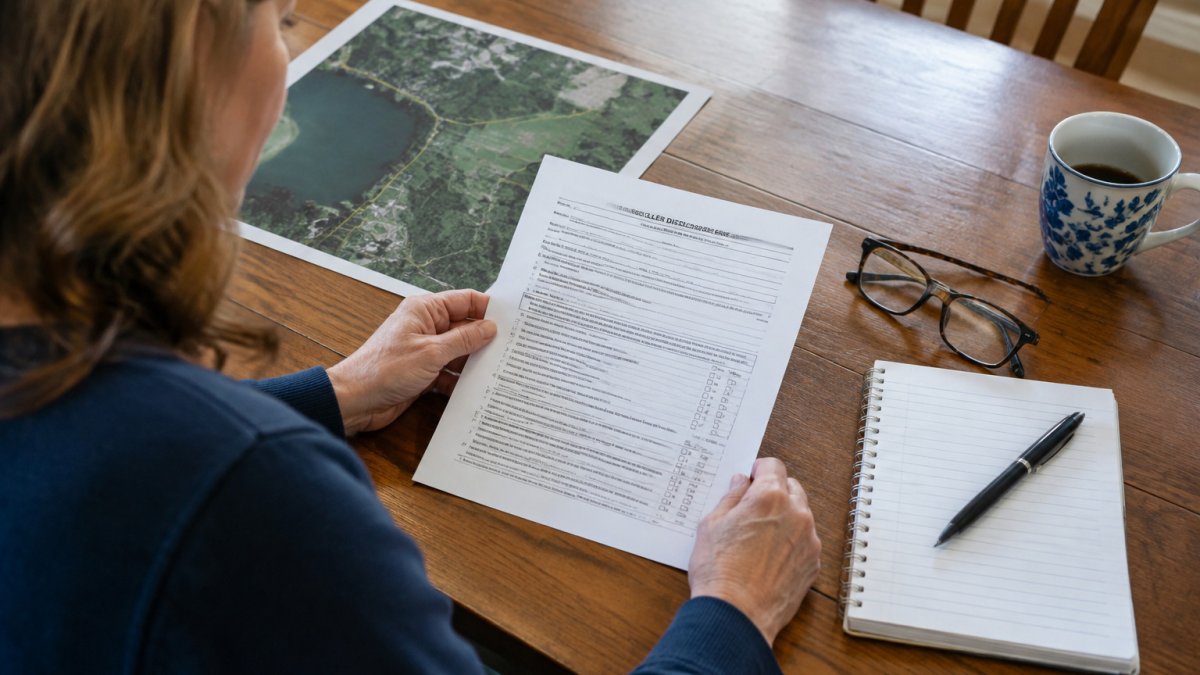
A buyer at a kitchen table reviewing a printed seller disclosure form beside a notepad and reading glasses, with a rural property map nearby
Many sellers in rural areas answer "yes" or "no" without detail.
Watch out: a blank section is not the same as a "no" answer.
Use this checklist when you review the disclosure:
- Does the form cover the water supply and wastewater system?
- Are repairs listed with dates and contractor names?
- Are easements, shared roads, or access rights described?
- Does any answer contradict the listing description?
- Are attachments such as tests or permits included?
Booking Your Inspections and Next Steps for Your Rural Purchase
A disclosure tells you what the seller knows. A home inspection tells you what the property actually looks like today. The two work together, and the disclosure does not replace an inspection. For rural properties, buyers often add specialized checks, such as a well flow and water quality test, a septic inspection, and a review of the land and boundaries.
Plan these steps early in the contract period. Your agent can help you find inspectors who work in rural areas.
A Practical Review Workflow for Rural Disclosures
Most buyers read the disclosure once and move on.
- Read the disclosure against the listing. Note any place where the disclosure and the listing disagree, a "recently updated" kitchen with no permits, a "great water" claim with no test on file, an "easy access" road that turns out to be private. Disagreements are questions, not conclusions.
- Pull the public records. Request the well driller's log, septic permits, and any building permits from the county. Compare the dates and scope in the records with what the disclosure says was done. A repair the seller describes but no permit exists for is worth asking about.
- Order the general home inspection. This covers the house itself, roof, structure, electrical, plumbing, HVAC, and gives you a baseline for everything else.
- Add the rural-specific inspections. A well flow test and water quality lab test, a septic evaluation, and, where the property has acreage, a boundary survey or a review of the plat and easements. These are separate services from a general inspection and often need to be booked with different providers.
- Reconcile the results. Put the disclosure, the inspection reports, and the public records side by side. Where all three agree, you can rely on the finding. Where they conflict, ask the seller for a written explanation and, if needed, a repair or credit before closing.
- Confirm what stays with the property. Rural purchases often involve items a suburban buyer never thinks about, a propane tank (owned or leased), a generator, a water softener, solar panels with a lease or financing agreement, and any shared road maintenance arrangement. Ask which of these convey and which have contracts attached.
Sequencing matters. The general inspection usually comes first because it can flag issues that shape which specialists you call.
If you have questions about a seller's disclosure or want to plan your rural purchase, you can reach out to Karin Kuhn, Realtor for guidance on the next steps.
Buyers who want to see what sellers in the area are expected to provide can review the process on the seller guidance page for the Kerr Lake area. For buyers preparing to move forward, the buyer guidance page explains the next steps from offer to closing.
A related guide on zoning rules for rural land in Virginia may also help if the property has acreage you plan to develop.
Ready to Move Forward on a Rural Home?
Rural property comes with questions that a standard listing does not answer.
Frequently Asked Questions
What should I look for in a seller disclosure?
Start with the sections on known defects, the water supply, the septic system, roof and structure, and any past flood or fire damage. For rural homes, check whether the seller has answered the well and septic questions in detail or left them blank. Vague answers such as 'not aware' deserve follow-up questions to the seller and your agent. Compare what the form says against the property history you can verify through county records and the inspection report.
Does a seller disclosure replace a home inspection?
No. A seller disclosure reports what the seller knows and is willing to state, while a home inspection is an independent examination of the property's condition by a licensed inspector. Rural buyers should order a separate inspection that covers the well yield and water quality test, the septic system, and the structure. The disclosure tells you where to look; the inspection tells you what is actually there.
What happens if a seller lies on a disclosure form?
A seller who knowingly misstates or conceals a material defect may face liability for damages, and a buyer may have grounds to rescind or seek compensation. Outcomes depend on state law and the facts, so buyers who suspect misrepresentation should consult a real estate attorney promptly. Keep copies of every disclosure, inspection report and written communication, because these records are what establish what the seller knew and when.
How can I find a seller's disclosure form before making an offer?
Ask your agent to request the seller's property disclosure statement and check whether it is posted with the listing in the MLS or in the documents available to buyers. Many states require the disclosure to be provided before the buyer signs a binding purchase agreement, so ask early. If the form is not available, request it in writing before you make an offer, and make the offer contingent on your review of it.