 How-to
7 Truths About Lakefront Property as an Investment
Last Updated: November 5, 2026
Quick Summary
Lakefront property can be a good investment, but only when you hold it for years, use it enough to justify the carrying cost, and budget for water-related risks. Treat it as a lifestyle asset with investment upside, not a guaranteed return or a short-term flip.
- Waterfront land is finite, and that fixed shoreline supply supports long-term demand.
- Flood insurance is usually excluded from standard homeowners policies and adds annual cost.
- Build a total-cost-of-ownership model over a seven to ten year holding period.
- Short-term rental rules vary by county, municipality, and subdivision, and can change.
- Well-kept waterfront homes generally retain value better than inland homes in the same market.
Table of Contents
- The Real Case for Buying Lakefront Property
- Lakefront Property Investment Risks You Cannot Ignore
- Lake House Ownership Costs Beyond the Mortgage
- Lake House Rental Income and Local Rental Rules
- Does Lakefront Property Hold Its Value Over Time?
- Weighing a Lake House Against Your Own Goals
- Frequently Asked Questions
The Real Case for Buying Lakefront Property
Is lakefront property a good investment? It can be, but not for the reasons most buyers assume. Whether it pays off depends on how long you hold it, how you use it, and what you pay going in.
Waterfront land is finite, you cannot manufacture more shoreline, and that scarcity supports long-term demand. But scarcity alone does not guarantee a profit, and buyers who get hurt usually treated a lake house like a stock instead of a home.
Scarcity and Demand Drive the Waterfront Premium
The premium is real. Lakefront lots and homes typically command more than comparable inland homes in the same market, because the supply of shoreline is fixed and the pool of buyers who want it stays steady.
That premium cuts both ways. You pay more to get in, so your gain has to come from holding the property while demand grows. The IRS guidance on capital gains on home sales is worth reading before you assume a fast resale is tax-free.
Lakefront Property Investment Risks You Cannot Ignore
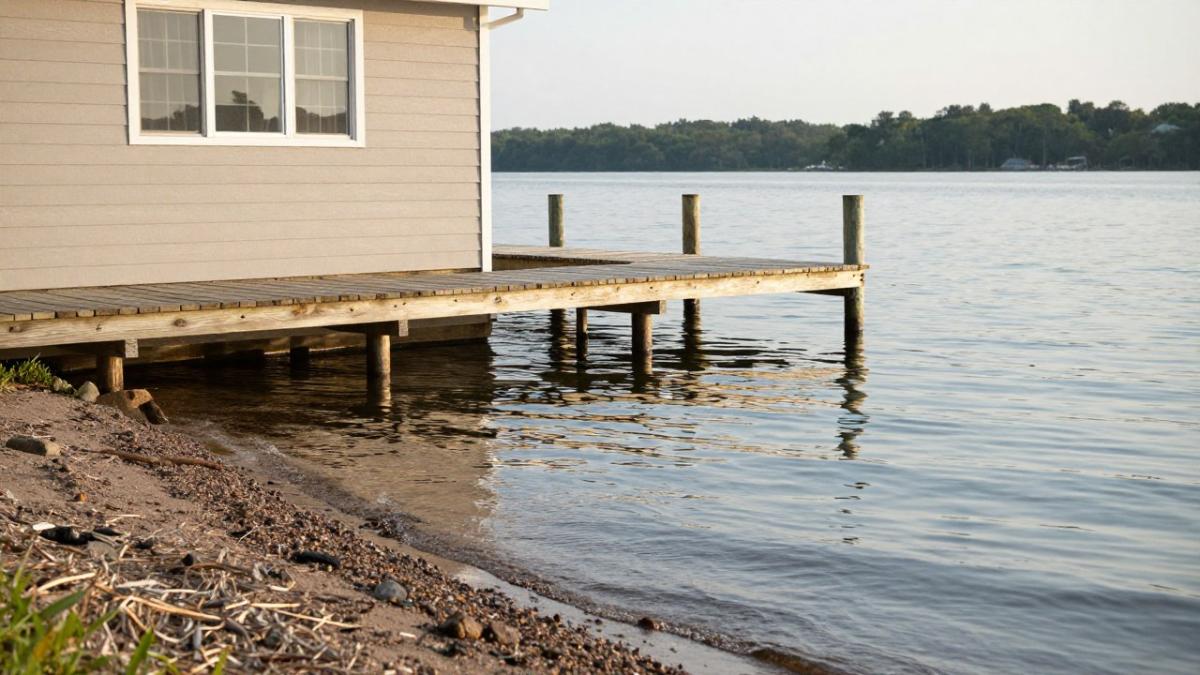
The biggest risk with lakefront property investment risks is not the market. It is the water itself. Shorelines move. Water levels rise and fall. Banks erode. A property that looks perfect in July can tell a different story after a wet spring.
Water Levels, Erosion, and Flood Exposure
Flood exposure is the risk buyers most often underestimate. Standard homeowners insurance usually excludes flood damage, and waterfront homes often sit in higher-risk zones. Check the FEMA flood maps for the specific parcel before you fall in love with it.
Erosion is slower but just as costly. A bank that loses a few feet a year can eventually threaten a dock, a seawall, or the house itself. Ask how the shoreline has changed over the past decade, and budget for stabilization if the bank is steep or bare.
Lake House Ownership Costs Beyond the Mortgage
Lake house ownership costs run well past the mortgage payment, and the gap between the two is where most lakefront budgets break.
Start with the carrying costs you will pay every year:
- Mortgage payment. Principal and interest on the purchase loan. Second homes and investment properties usually price higher than a primary residence, and a larger down payment is common.
- Property taxes. Assessed on the waterfront value, which is often higher than an inland comparable. Rates vary by county, so pull the actual tax bill for the parcel rather than estimating from the list price.
- Flood insurance. Standard homeowners policies generally exclude flood damage, and many waterfront parcels sit in a higher-risk zone. Lenders frequently require separate coverage, and the premium can be a meaningful annual line item. Check the FEMA flood maps for the specific parcel.
- Homeowners insurance. Waterfront homes typically cost more to insure than inland homes because of wind, water, and access exposure.
- Utilities and seasonal costs. Heating, cooling, well and septic electricity, plus winterization and spring opening if the home is seasonal.
- Maintenance and lawn care. Many owners plan for ongoing upkeep as a percentage of the home's value each year, with waterfront properties often needing more.
- Dock and shoreline upkeep. Dock maintenance, permits, and repairs, plus a reserve for erosion or shoreline stabilization work.
- Septic care. If the home is not on public sewer, budget for inspection and pumping on a regular cycle.
- HOA or lake association dues. Many lake communities charge annual dues for road maintenance, water quality programs, or shared amenities.
Add those up and you have the annual carrying cost. Then add the one-time costs: closing costs on the purchase, and selling costs when you exit. A simple model looks like this:
- Total cash in = down payment + closing costs + cumulative carrying costs over the holding period + capital repairs.
- Total cash out = sale price at exit minus selling costs and any mortgage payoff.
- Net result = total cash out minus total cash in, expressed as a dollar figure and as an annualized return on the cash you put in.
Run that model with conservative assumptions and again with optimistic ones.
Watch out: a model that assumes peak-season occupancy, flat insurance premiums, and no shoreline work will flatter the numbers.
A second model worth running is rent-versus-own.
Here are the annual carrying costs to build into a lake house budget before you buy.
| Cost item | What it covers | Note |
|---|---|---|
| Mortgage payment | Principal and interest on the purchase loan | Second homes and investment properties usually price higher |
| Property taxes | Assessed on the waterfront value | Often higher than an inland comparable |
| Flood insurance | Separate coverage for flood damage | Standard homeowners policies generally exclude flood |
| Homeowners insurance | Wind, water, and access exposure | Waterfront homes typically cost more to insure |
| Utilities and seasonal costs | Heating, cooling, well and septic electricity | Plus winterization and spring opening if seasonal |
| Maintenance and lawn care | Ongoing upkeep as a percentage of home value | Waterfront properties often need more |
| Dock and shoreline upkeep | Dock maintenance, permits, repairs | Plus a reserve for erosion or stabilization work |
| Septic care | Inspection and pumping on a regular cycle | Only if the home is not on public sewer |
Lake House Rental Income and Local Rental Rules
Start with the rules, not the rate. Short-term rental rules vary by county, municipality, and subdivision.
Then subtract the real costs:
- Property management fees, often a percentage of gross rent, if you hire a manager
- Cleaning and turnover costs between stays
- Supplies, linens, and welcome amenities
- Platform listing fees
- Lodging or transient-occupancy taxes
- Permits and licensing fees
- Additional insurance for rental use
- Higher maintenance from guest wear and tear
- Utilities that run higher when the home is occupied
Then compare to the carrying cost. Net rental income is gross rent minus those costs. Compare that net figure to the annual carrying cost from the ownership-costs section.
Watch out: a market that allows short-term rentals today may restrict them later.
A useful stress test is to run the rental model at 50% of your expected occupancy with management fees included.
Does Lakefront Property Hold Its Value Over Time?
Does lakefront property hold its value? Because shoreline scarcity cannot offset deferred maintenance or costly repairs, hiring a general contractor can help protect the property’s long-term value.
Value holds when the shoreline is stable, water access is good, and the home is maintained. It slips when erosion, flood damage, or deferred maintenance pile up. To judge the market yourself, browse current listings in the region and compare waterfront pricing against inland homes.
Weighing a Lake House Against Your Own Goals
A lake house makes sense as an investment when three things line up: you plan to hold it for years, you will use it enough to justify the carrying cost, and you have budgeted for the water-related risks. It makes less sense as a short-term flip or as a substitute for a diversified portfolio. Treat it as a lifestyle asset with investment upside, not a guaranteed return. When you are ready to act on that case, see Buyers Buying a Home in the Kerr Lake and Clarksville Area.
If lake life fits your goals, the next step is understanding the move itself. Our relocation guide covers what to expect when moving to the area. And when you are ready to talk through specific properties or ask questions, you can get in touch directly. Karin Kuhn, Realtor has over 30 years of experience in the Kerr Lake region and is licensed in both Virginia and North Carolina. We would be glad to walk you through the numbers on any property you are considering.
Frequently Asked Questions
Does lakefront property hold its value?
Waterfront homes generally hold value better than inland homes in the same market because buildable shoreline is limited and demand stays steady. That said, holding value depends on the specific lake: water quality, access, and local demand all matter. A lakefront property on a shrinking or polluted lake can lose value while nearby inland homes rise. Before buying, review recent sale prices for comparable waterfront homes and ask how long they sat on the market.
What are the downsides of owning a lakefront property?
The main downsides are cost and risk. Lake house ownership costs run higher than inland homes: flood insurance, dock and seawall upkeep, erosion control, and seasonal repairs all add up. You also face environmental risk from fluctuating water levels, plus local rules on docks, shoreline buffers, and short-term rentals. Some owners find the property sits empty for much of the year, which means carrying costs without rental offset.
Can you make money renting out a lake house?
Yes, but the math is tighter than most buyers expect. Lake house rental income is highly seasonal, with most bookings concentrated in summer. Factor in vacancy during the off-season, cleaning and turnover, property management fees, and local short-term rental rules before counting on revenue. Run a break-even calculation using realistic occupancy, not peak-season numbers. A property that cash-flows in July may run negative in January.
Is a lake house a better investment than stocks?
They behave differently. Stocks are liquid and diversified; a lake house is a single, illiquid asset with high transaction costs. Lakefront property can deliver appreciation and rental income, but it also carries concentrated risk from water levels, local regulations, and market shifts. Many buyers treat a lake house as a lifestyle purchase with investment upside rather than a pure financial play. Compare total cost of ownership against expected returns before deciding.
Buying on the water is a big decision, and the details matter. Karin Kuhn, Realtor brings over three decades of local experience, specialized knowledge of lakefront and waterfront properties, and strong negotiation skills to every transaction. Get started with Karin Kuhn, Realtor and move forward with confidence and peace of mind.